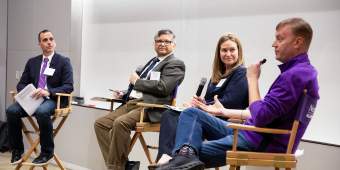
Recently, the Northwestern Alumni Association invited me to join a panel of technology leaders to unpack what they called "the 2030 Roadmap." The event was the inaugural gathering of Northwestern Alumni in Tech, a new network designed to go beyond the headlines and into the harder questions about where the industry is actually headed.
I wanted to share some of what came up, not as a recap, but as an attempt to go a little deeper on the things that felt most true.
On separating signal from noise — and what AI has changed about that
NU asked me about the filter. How do you know, after building over 100 digital products across two decades, which technology waves matter and which ones are just heat? With each wave of new tech (mobile, cloud, blockchain, machine learning, AI) how does TXI separate the signal from the noise?
The honest answer is that the process hasn't changed as much as you'd think.
At TXI, we've always started with the same question: does someone's day get meaningfully better if this exists? Not "can we build this?" (because anyone can answer that question). But "is there a human need undeniable enough that the technology finally being capable of meeting it actually changes something?" Mobile was a signal. Low-code for enterprise was mostly noise. The cloud was a signal, not because it was new, but because it unlocked something real for the people building and using software.
The technologies that stuck were always the ones where the human need was already there, waiting.
The noise comes from asking the wrong question: “What does this technology do?” What AI has changed is the pace of the noise. The hype cycle used to be measured in years. Now it moves in weeks. A new model, a new capability, a new demo,every day,each one promising to change everything. That compression is genuinely disorienting, even for people who've been in this industry a long time. For those chasing the wrong question of “what can the technology do?” there is an ever increasing amount of noise related to that.
The signal comes from asking a better question: “What problems am I trying to solve?” When we look at AI through the lens of our clients, the signal lives in the places where judgment, prediction, and pattern recognition at scale actually move the needle on real operational problems. Not the demo. The deployed thing, six months later, that someone is actually relying on.
I find it exciting, not unsettling. It means the people who stay anchored to human outcomes, who keep their judgment in the loop, have more leverage now. The risk is for organizations that outsource their judgment entirely. The opportunity is for the ones who augment it wisely.
On leadership approaches that worked before (and won't carry us to 2030)
For most of my career, the implicit contract of leadership was: you should seem like you know. The leader was supposed to be the smartest person in the room. Confidence was currency and uncertainty was considered weakness. And I think that contract and perception is breaking down, and fast.
The pace of change now means a leader's "expertise" can become obsolete in 18 months. The people closest to the work often understand what's actually happening faster than the people at the top. And the talented employees you most need to keep can sense immediately when a leader is projecting confidence they don't actually have. That inauthenticity costs you more than the vulnerability of admitting uncertainty ever would.
The shift I've had to make personally is from being the answer to creating the conditions for answers to emerge. It requires you to genuinely believe, not just say, that your team's intelligence distributed across a problem is more powerful than your intelligence concentrated on it. That requires both a cultural and leadership shift toward more employee engagement, more active listening, and a willingness to listen and learn as a CEO.
There's a close second worth naming: the habit of building for harmony rather than for truth. A lot of leadership thinking from the last decade optimized for cohesion, positivity, cultural fit. And there's real value in belonging and psychological safety. But there's a shadow side to that impulse. It can slide into softening hard messages, rewarding agreement over dissent, building teams where everyone thinks alike. Which feels efficient. Which feels nice (especially in the midwest - where “midwest nice” means no feedback or challenging assumptions are the norm). But this quietly drains an organization of the creative friction it actually needs to innovate.
We've seen this in our own data at TXI. The leaders who will thrive heading into 2030 are the ones who can hold both: genuine belonging and the courage to surface uncomfortable truths. Who can say "I don't know" and "we were wrong about that" with the same steadiness they used to say "here's the plan."
And one more, subtler but important: the default archetype of what a "strong leader" looks like. For most of my career, that unspoken model has been a particular kind of person that is decisive, comfortable taking up space, often from a narrow set of backgrounds. We've built management systems and promotion paths around that archetype in ways we often didn't even notice.
The organizations that win heading into 2030 will be the ones that get genuinely curious about the leadership talent they've been overlooking. That's not just an equity issue. It's a performance issue. The leaders who will matter are the ones who can create clarity without owning every answer, hold truth without sacrificing belonging, and build environments where leadership emerges at every level — not just from the top.
On what clients are actually asking for now
Two years ago, most of our client conversations started with structuring data (how to collect it, store it, organize it). The goal was visibility: dashboards, reports, a single source of truth for a user to read and interpret.
Those conversations have shifted. Clients aren't asking for data to just look at anymore. They're asking for systems that think with them and applications that surface the right insight at the right moment, which learn from operational patterns, and applications that move from showing what happened to informing what to do next. The framing we use internally is the shift from digital products to intelligent products: software that doesn't just record and display, but reasons and recommends.
What that tells us about where industries are headed is this: the bottleneck has moved. It's no longer about getting data into a system. It's about having the judgment to know which questions to ask of it and the organizational trust to act on what it surfaces.
On the human skills that matter more, not less
Northwestern saved perhaps the most interesting question for last: in a world where AI can do more and more of the technical work, what human capabilities are actually becoming more valuable?
My answer: judgment and the ability to earn trust in hard rooms.
AI can write the code. It cannot walk a factory floor. It cannot sit across from a resistant VP of Operations and find the frame that gets them to yes. It cannot hold a client relationship through a genuinely difficult moment and come out the other side with more trust than you started with.
That is what TXI excels at. When I examine the 25 year history here, we were never really in the software business. Software was the artifact. We were always in the business of helping smart organizations make better decisions about technology, faster than they could alone.
AI doesn't threaten that business. If we move correctly, it makes it more valuable because the clients who need us are now surrounded by tools they don't know how to use wisely. What they need isn't more capability. They need judgment about which capability to trust, in which context, toward which outcome.
Building custom software, the thing we've spent 20 years getting really good at, is no longer the hardest part. The hard part is walking into a manufacturing plant, earning the trust of a room full of skeptical operators, understanding what's actually broken, and knowing which problem is worth solving first.
That is what we do. That is what we have always done, even when we described ourselves as a software company. Thankfully, we have always been a judgment company that cared about outcomes far more than just code. And judgment, it turns out, is exactly what this moment is asking for.
About the author
Mark Rickmeier is CEO at TXI, where he leads an international team building intelligent products for modern industrial leaders. He focuses on helping organizations move innovation from pilots to production outcomes that scale. Mark also founded the Kermit Collective, a community where consulting leaders collaborate to drive shared success.
TXI partners with industrial organizations navigating the shift from digital to intelligent systems. If you're trying to figure out which problems are worth solving first, that's exactly where we do our best work. Let's talk.