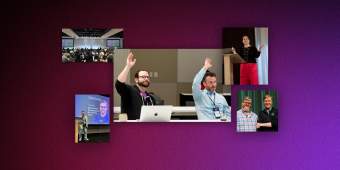
A few weeks ago, TXI helped bring Accelerate Chicago 2026 to life, not as a sponsor, but as an organizer and a speaker. Accelerate Chicago is a new conference, so it is worth starting with why we thought Chicago needed it in the first place.
The shift to remote work changed the way Chicago's technology community connected.The informal conversations, introductions across a conference table, and moments when you realized the person next to you was working through a problem surprisingly close to your own became harder to come by.Slack and Zoom kept us connected, but they did not fully replace those in person connections. And for a few years, our community thinned. Not dramatically, just enough to feel the distance.
Chicago has always punched above its weight in software. Engineers here build things that have to work in the real world, from hospitals and factory floors to financial systems where failure has real consequences. There's a pragmatism to this community that I've respected for over two decades. But communities need spaces to see themselves. To compare notes. To find the next collaborator sitting two tables away, working on the exact same problem from a completely different angle. Some of the best conference conversations happen in the hallway or over lunch. For me, that is a big part of the value.
TXI has been building in Chicago since 2002. We've grown through referrals, through relationships, through the kind of serendipitous connections that only happen when you're genuinely embedded in a place. That history is part of why helping organize Accelerate Chicago made sense to me. I wanted to contribute to the kind of technology community that has supported TXI for more than two decades. I believe a stronger, more connected Chicago engineering community makes TXI better, makes our clients better, and makes this city better.
So: what was it, actually? Accelerate Chicago 2026 was a multi-day, in-person gathering for software engineers, product leaders, designers, and technical executives, organized around the questions defining our industry right now: AI and intelligent systems, engineering culture, data-powered products, and what it takes to lead technical teams through a moment of real change. A room built for depth over breadth, and for builders to leave with new ideas, new contacts, and a renewed sense of what's possible when Chicago's technologists actually get in a room together.
Building the program
Once I committed to helping organize the event, I joined the weekly planning calls (some of them at 7am, to sync with the team in Europe). And going in, I knew one thing for certain: as a technical, engineering-driven conference in 2026, AI was going to dominate the agenda. That was fine. But I didn't want it to be the only conversation in the room, and I didn't want it to sound like every other AI conference stage.
So I pushed on three fronts.
First, make sure AI showed up in its most human-consequential form, not just its most impressive one. I introduced the committee to Sam Smith, Senior Staff Accessibility Lead at Coinbase, who'd already spoken to all of TXI as part of our Q2 disability justice education arc. His talk, Proactive Inclusion: Embedding Accessibility into the AI Revolution at Coinbase, made sure accessibility had a real seat at the table, not as an afterthought panel, but as a core AI track.
Second, make sure we didn't forget the human in the process, including in sessions that had nothing to do with AI at all. I brought in Tanarra Schneider, who coaches our own leadership team, to talk about the human infrastructure underneath technical strategy, The Stack You Can't Refactor. And I introduced the committee to Gayle Silverman, one of our own team members, whose talk on "glue work" (the invisible, unglamorous labor of onboarding, untangling miscommunications, and holding teams together, which falls disproportionately on women) had nothing to do with AI whatsoever. It didn't need to. Not everything worth discussing at a technical conference is about technology. For example, I invited Jessie Shternshus, co-founder with me of the Kermit Collective (our effort to get competitors collaborating instead of just competing), to open the conference with How to Be a Curiosity Curator. She kicked off the session with her typical flair for improv, innovation, and insight to help connect people in the room together and remind everyone why curiosity is so important today.
Third, make this feel like Chicago's conference, told in Chicago's voice. I wanted local leaders, not just the usual circuit of national keynote speakers, anchoring the day. So I introduced the committee to Dr. Serena Huang, founder of Data with Serena and a Chicago leader I deeply respect but who hasn’t (yet) shared a stage with TXI. She closed the conference with How to Stay Human in the Age of AI. I wanted her voice in the room specifically because it wasn't already familiar to us. I'll say it plainly: I didn't want this to be another conference guided only by the white, male, developer voice, however well-intentioned that voice might be.
A lot of the people I recommended were already part of conversations happening inside TXI. They were advisors, coaches, team members, or people who had challenged my company’s thinking in useful ways. If something helped us get better as a company, my instinct was to ask: is this bigger than us? Almost always, the answer was yes. Force-multiplying what already worked internally, out into the wider community, felt like the whole point of showing up as an organizer rather than just a sponsor.
What we chose to share
TXI also contributed three sessions to the program, each based on work or ideas our team has been actively exploring. Kyle McCluskey, one of our data engineering leads, gave a deeply technical talk, Spec-Driven Development for Airflow DAGs, walking through exactly how we're using AI coding assistants to generate ETL and ML pipelines for heavy-industry clients, with real examples from our rail and renewable energy work. He shared the same approach our teams are using in the work today. Gayle Silverman took the "glue work" conversation further, sharing how we ran an internal Tournament of Glue Work, a bracket-style exercise to surface and prioritize the invisible labor holding our teams together, and how naming it changed the way we talk about fairness and recognition on engineering teams.
And I gave the keynote alongside our partner Brian Martin, Chief AI Product Owner at AbbVie. We didn't talk about TXI. We talked about Rare Hopes, a self-funded nonprofit built on a collaboration between tellic LLC's 911-million-edge knowledge graph, AbbVie's biomedical research, and TXI's human-centered product design. Together, we're mining over 53 million scientific documents to surface connections no single researcher could find. In one case, the system linked 15 papers spanning 40 years to identify an existing drug, Ruxolitinib, as a potential treatment for Carney Complex, a rare genetic disorder with no known therapy. The model didn't just find a needle in a haystack. It found a needle no one knew to look for. My keynote highlighted that finding the connection was only part of the challenge. The next question was whether a doctor or researcher can understand and use what the system found. In the end, my talk was really about what it takes to turn a knowledge graph into something a doctor or a patient can actually trust and use. That was the question I wanted people to leave with: once AI finds something useful, how do we make sure the person who needs that information can trust it and act on it?
None of these three talks were TXI sales pitches. They were TXI's real, current thinking, handed to a room full of people (some of whom compete with us) because accessibility, glue work, and building AI that people can actually trust are bigger than any one company's competitive edge. If TXI has learned something that makes the industry better at serving people, keeping it to ourselves was never really the point.
Why this, why now
Chicago doesn't need another conference that talks at it. It needs rooms where the density of connection comes back; where the hallway conversation is the point, not the byproduct. That's what I was trying to help Accelerate Chicago with in 2026: an event organized with real intention about who gets the mic and why, and a stage TXI was willing to use for something other than talking about ourselves.
I plan to keep showing up for Chicago's technology community. For 25 years now, TXI has been part of this connected ecosystem, and I want to help create more opportunities for the people building here to learn from one another, meet someone new, and stay connected.